County Galway —
Colourful Streets & Wild Atlantic Adventures
A little music, a lot of scenery and enough Atlantic air to blow the cobwebs away.
There's something about Galway that makes people want to come back.
Maybe it's the trad music drifting out of pub doorways, the colourful shopfronts or the Atlantic breeze. Maybe it's the wild landscapes waiting just beyond the city. Whatever it is, Galway has personality to spare.
From the Latin Quarter and Salthill Prom to the wild beauty of Connemara, there's huge variety here, and that's before you even get to the Aran Islands, the castles and some of Ireland's most breathtaking coastal roads. Whether you've a day, a weekend or a proper west-of-Ireland adventure, give Galway plenty of time.
🎻 Galway City & the Latin Quarter
Galway is famous for its buzz: colourful streets, buskers on every corner and a thriving arts and music scene. The Latin Quarter is the heart of it, with narrow streets packed with independent shops, cafés and pubs.
Wander down Quay Street to the Spanish Arch, cross to the historic Claddagh, and soak up the bustle around Eyre Square. The Galway City Museum is a great introduction to the city's story.
Why visit? City breaks, culture, traditional music and historic streets.
🌅 Salthill Promenade
No Galway visit is quite complete without a stroll along the prom. It runs beside Galway Bay, with views across the water to the hills of the Burren in Co. Clare.
Come for a walk, a coffee or simply to watch the Atlantic weather roll in. And if you're feeling traditional, do as the locals do and kick the wall at the end of the promenade before turning back.
Why visit? Coastal walks, sunsets and Galway traditions.
🚲 The Aran Islands
Off Galway's Atlantic coast lie the three Aran Islands: Inis Mór, Inis Meáin and Inis Oírr, famous for their traditional culture, stone walls and dramatic coastal scenery.
On Inis Mór, the prehistoric stone fort of Dún Aonghasa sits right at the edge of sheer Atlantic cliffs. It's one of the most extraordinary sights in Ireland. Explore by bike, on foot or with a local tour.
Why visit? Island adventures, archaeology, cycling and Irish culture.
🏰 Portumna Castle & Gardens
Over in East Galway, Portumna Castle shows a different side of the county. It was built in the early 1600s by the 4th Earl of Clanricarde, burned in 1826 and has been carefully restored by the State.
The formal gardens and walled kitchen garden are a treat, and next-door Portumna Forest Park adds woodland walks beside Lough Derg.
Why visit? Historic houses, gardens, forests and quieter attractions.
🏰 Kylemore Abbey
With its mountain backdrop and lakeside setting, Kylemore Abbey almost doesn't look real. It was built in the 19th century as a private home and later became home to a community of Benedictine nuns.
Explore the abbey's history, wander the beautifully restored Victorian Walled Garden and enjoy the peace of the lake.
Why visit? History, architecture, gardens and photography.
⛰️ Connemara National Park
This is where Galway's landscape goes properly wild: mountains, bogland, heather-covered hills and huge views in every direction.
The park has several walking routes, with Diamond Hill the best known, and you'll learn about the landscape and ecology along the way.
Why visit? Hiking, nature and spectacular scenery.
🛣️ Clifden & the Sky Road
Clifden, often called the capital of Connemara, is a lively town and a great base for exploring the region.
The Sky Road loop is the star: huge views of the Atlantic, offshore islands and rugged coastline. Take it slowly and only pull in where it's safe to stop.
Why visit? Scenic road trips, photography and village exploring.
🏖️ Roundstone
A picturesque village with colourful buildings and harbour views. Nearby Gurteen Bay and Dog's Bay have pale sands and turquoise water that can look almost Mediterranean on a sunny day. (The water temperature will quickly remind you it isn't!)
Why visit? Beaches, coastal scenery and charming villages.
🌊 Killary Harbour & Leenane
Killary Harbour is a dramatic glacial fjord on the Galway–Mayo border, hemmed in by mountains. The village of Leenane makes a lovely stop on a Connemara road trip.
Why visit? Mountain scenery, scenic drives and photography.
📸 Dunguaire Castle & Kinvara
On the shore of Galway Bay near Kinvara, the 16th-century tower house of Dunguaire is one of the most photographed castles in Ireland. Kinvara itself is a pretty village with a lovely harbour.
Why visit? Coastal photography and a charming village.
A mix of free outdoor places and ticketed attractions, labelled so you can plan around them.
🌊 Omey Island
A tidal island near Claddaghduff that you can reach on foot across the sand at low tide. It has a ruined church and a holy well linked to St Feichin, who founded a monastery here in the 7th century.
✈️ Derrigimlagh Bog
Near Clifden, this bog has two big claims to fame. It was the site of Marconi's transatlantic wireless station, and in 1919 Alcock and Brown crash-landed here at the end of the first non-stop transatlantic flight. A looped walk tells the story.
🐦 Inishbofin
An island west of Connemara with great walking, plenty of wildlife and a wonderfully remote atmosphere. Ferries run from Cleggan.
🌿 Brigit's Garden
A Celtic-themed garden near Rosscahill, designed around the four seasonal festivals of the old Irish calendar: Samhain, Imbolc, Bealtaine and Lughnasa.
🏰 Aughnanure Castle
Near Oughterard, this striking 15th-century tower house was the stronghold of the O'Flaherty lords of West Connacht for over two centuries.
📚 Coole Park
Near Gort, Coole Park was the home of Lady Gregory and a gathering place for the writers of the Irish literary revival. Look for the famous Autograph Tree, carved with initials including those of W. B. Yeats.
🗼 Thoor Ballylee
The medieval tower that W. B. Yeats bought, restored and lived in, and which inspired some of his best-known poetry. It's run by the Yeats Thoor Ballylee Society.
🎬 The Quiet Man country
Fans of The Quiet Man will want to see Cong, where much of the film was shot. Note that Cong is just over the border in County Mayo, not Galway, but it's an easy detour from north Galway and Connemara.
💎 Love this kind of find?
Our Hidden Ireland collection is where we keep the places most visitors drive straight past.
We've kept history and legend clearly labelled, because the best Irish stories are usually a bit of both.
💍 The Claddagh Ring
The Claddagh ring is one of Galway's most famous symbols: two hands holding a heart, topped with a crown, representing friendship, love and loyalty. It takes its name from the Claddagh, the old fishing community just across the river from the Spanish Arch.
Popular tradition credits its design to a Galway man, Richard Joyce, said to have learned goldsmithing while held captive abroad. It's a lovely story, but as with many legends, the details are hard to prove.
🏰 Dunguaire Castle: kings, poets and banquets
Legend links the site to Guaire Aidne, a 7th-century king of Connacht famous for his generosity. Folklore says he was so generous that his right arm grew longer from giving.
The history is easier to pin down: the tower house was built in the 1500s, and in the 20th century it was owned by the writer Oliver St John Gogarty, whose circle included figures of the Irish literary revival. Later, it became known for its medieval banquets.
⚓ Grace O'Malley and the west coast
Grace O'Malley (Gráinne Mhaol), the famous 16th-century sea captain and chieftain, commanded ships along Ireland's western seaboard. Her base was mainly in neighbouring Mayo, but her story is part of the wider maritime world of the west of Ireland, a world of trading, raiding and fierce independence.
👻 Fancy more Irish legends?
Our Friday Night Frights series explores ghost stories, myths and folklore from all over Ireland.
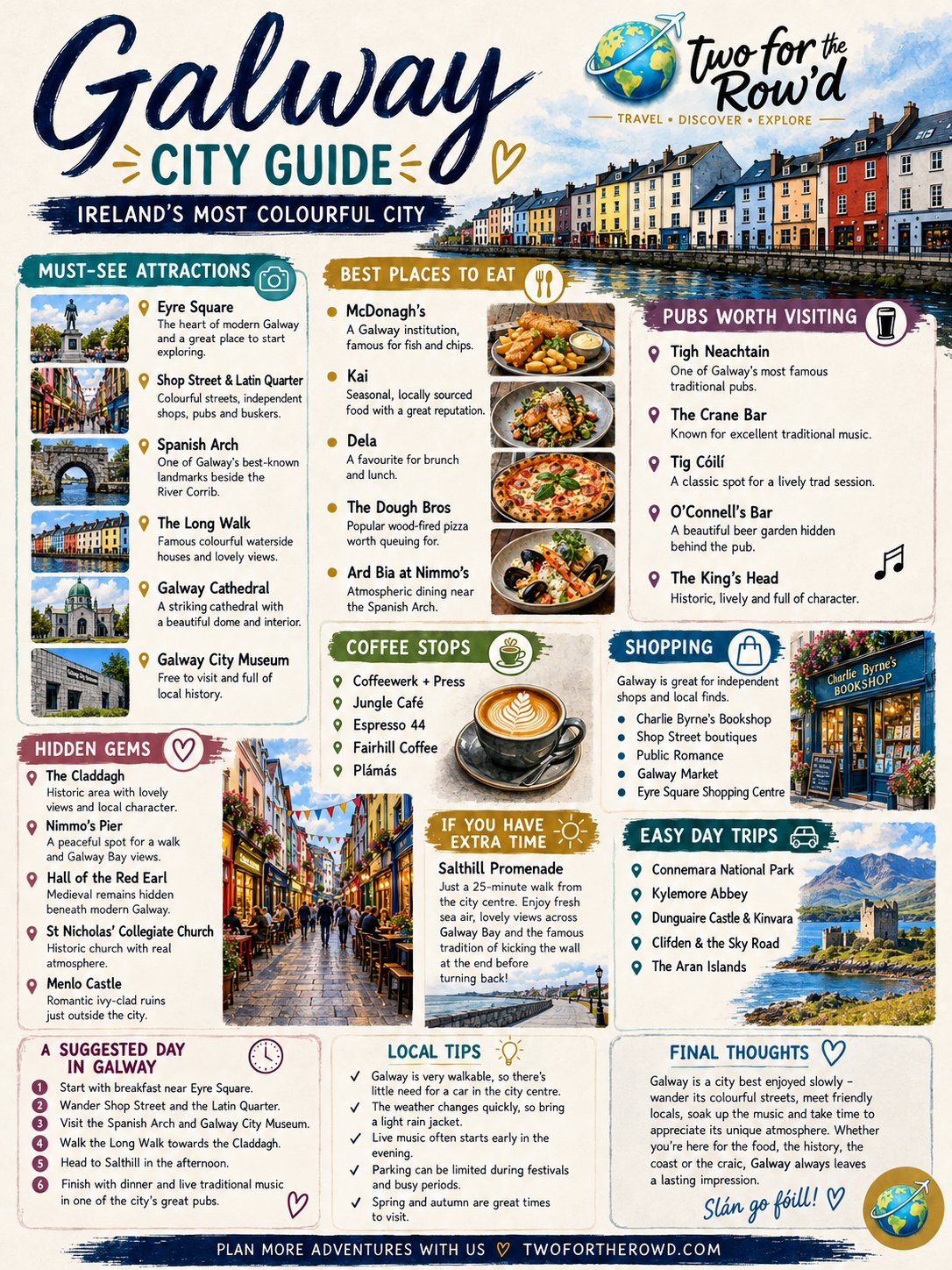
📋 Our Galway city guide
Prefer everything on one page? Our Galway city guide brings together the big sights, places to eat, trad pubs, coffee stops, shopping, hidden gems and easy day trips.
Tap the guide to open it full size, so you can save it to your phone or print it.
Three realistic days out. Each one sticks to one part of the county, so you spend more time exploring and less time driving.
🎻 One day in Galway city
- Morning: Eyre Square, then wander into the Latin Quarter.
- Midday: Galway City Museum and the Spanish Arch.
- Afternoon: cross to the Claddagh, then head out to Salthill Promenade (a longer walk or a short bus ride).
- Evening: back to town for food and music.
⛰️ Connemara road trip
- Start: Galway, heading west to Oughterard.
- Late morning: Kylemore Abbey and its Walled Garden.
- Afternoon: a walk in Connemara National Park.
- Finish: Clifden. On a long day, add the Sky Road, but leave time for stops.
📚 South Galway heritage
- Morning: Coole Park near Gort.
- Lunch: in Kinvara, with a stroll around the harbour.
- Afternoon: admire Dunguaire Castle from outside (it's currently closed to visitors).
Prefer a guide, a ready-made tour or someone else to do the driving? These are good places to start:
Search current tours from Galway city, including walking tours, Connemara and Kylemore day trips, and Aran Islands trips.
Compare hotels in and around Galway city.
Our pick if you'd rather someone else drove: the 10-day Wild Irish Experience, which includes Connemara and Kylemore Abbey.
Disclosure: GetYourGuide, Klook and TourRadar links are affiliate links. If you book through them, we may earn a commission at no extra cost to you. Tours on TourRadar are our picks, not trips we've taken ourselves. Availability and prices change, so always check the provider's page before booking.
City breaks, trad music, dramatic scenery, island trips, walking and culture.
Galway city is walkable and has public transport. A car is useful for Connemara and rural East Galway. The islands need a ferry or other suitable transport.
Two to three days for the city and a few nearby sights. Four to six days if you want Connemara and the islands too.
Spring to early autumn for outdoor plans, but Galway city is great all year round.
Salthill Prom, city walks, free museums like the Galway City Museum, beaches and scenic viewpoints.
City museums, galleries, historic buildings and a long lunch with live music.
Opening times, ferry schedules and access arrangements change, so please check official websites before you travel. For general visitor information, see Discover Ireland.
Galway borders several of our county guides, so it's easy to build into a bigger west and midlands trip:
Slán go fóill, and safe travels! — Nicola & Podge